

Hook and Squeeze
How Democratic consultants, committees, and party leaders built a fundraising spam pipeline that funnels money from a captive pool of elderly donors into their own operations.

This investigation was originally developed for The New York Times, where it underwent eight months of editing, multiple rounds of fact-checking, and independent replication of the underlying methodology. The piece had a scheduled publication date when requests for comment were sent. It was only after the Times reached out to the subjects of the investigation for routine comment that the Elias Law Group, representing the DCCC and DSCC, sent a cease-and-desist letter demanding the paper not publish. Although the paper’s fact-checkers and legal department later cleared the piece before sending out a second round of requests for comment, the Times ultimately decided to kill the piece.
The piece was subsequently slated for publication at The Bulwark, where it underwent additional fact-checking, data verification, and legal review. When requests for comment were sent to the subjects of the investigation, lawyers representing the Progressive Turnout Project and Mothership Strategies likewise responded with legal letters demanding that the article not run. From there, publication was repeatedly delayed. The piece cleared successive rounds of legal review. When I asked for a committed publication date after months of delay, The Bulwark conditioned publication on my accepting an extensive rewrite prepared by its editors that, in my assessment, removed key empirical findings without explanation, introduced claims contradicted by the data and fact-checking record, and presented the subjects' legal defenses as my own conclusions. When I declined to publish under those terms, the piece was released back to me.
What follows is the complete investigation that emerged from this year-long process.
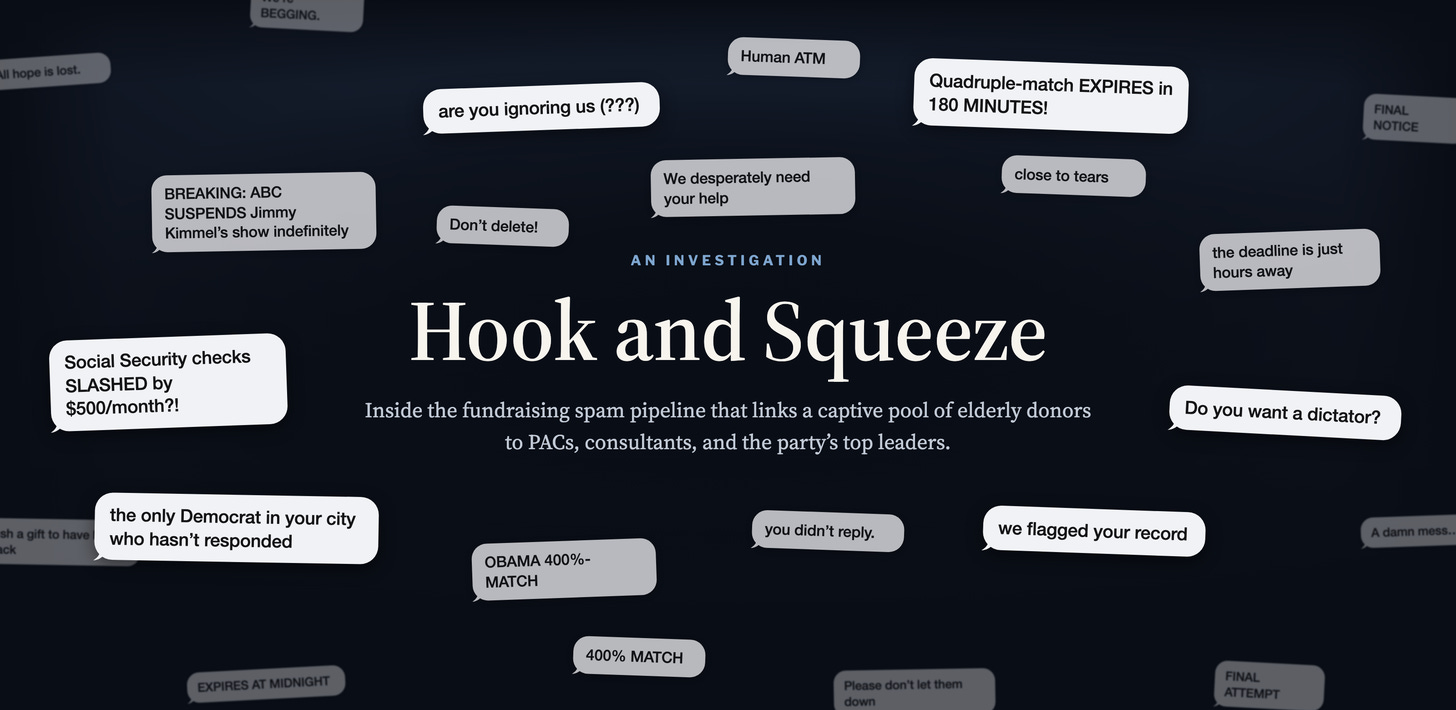
If you’ve ever donated to a Democratic campaign, you know the messages never stop: “All hope is lost.” “We’re BEGGING.” “Quadruple-match EXPIRES in 180 MINUTES!” They arrive at all hours, claiming to be “close to tears” because you haven’t sent $15.
Most of us dismiss them as annoying spam. But federal election records reveal a hidden population of seniors for whom these messages prove surprisingly effective. What reads as parody to one recipient may be psychologically triggering for another.
To understand how this system works, I combined contribution data from the Federal Election Commission with age data from voter registration lists, covering more than 300 million donations. The donors who send money in response to Democratic fundraising spam are overwhelmingly elderly, and a surprisingly concentrated group of them accounts for the bulk of the money raised.1
Looking closely at the donation data can be heartbreaking. An 85-year-old retiree in Oxford, Ohio made more than 7,800 donations totaling over $648,000 to Democratic causes, more than double the estimated value of his home. A 91-year-old woman residing in a senior living facility in Indianapolis donated over 25,000 times, totaling over $250,000, burning through money she may need for care.
As The New York Times reported in 2021, the all-caps writing and manufactured panic of political fundraising spam function as a filter, repelling savvy donors and taking advantage of the same cognitive vulnerabilities that make seniors targets for online fraud. A 2024 CNN investigation quoted a complaint from one person who discovered that their 93-year-old father was being inundated with Democratic donation appeals. “These fraudsters need to stop defrauding older people,” it read, “especially ones with mental impairments.”
Who is behind this flood? A thriving industry of digital-fundraising consultants who specialize in offering spam as a service, and the political action committees and candidates who adopt their methods. Together, they form a broader network of fundraising that deploys these methods at scale.
The most visible players in this ecosystem are what I call “spam PACs” — organizations that use high-volume digital fundraising firms to raise small-dollar contributions, only to sink a disproportionate share of those funds right back into fundraising.2 They are built on a common financial model: outsized spending on aggressive digital messaging that repeatedly extracts donations from a disproportionately elderly group of donors. But these tactics have spread throughout the party. Even the party’s own congressional campaign committees and some of its most senior leaders have embraced the spam.
Republicans went all-in on these tactics first and offer a cautionary tale. After flooding supporters’ phones with fundraising spam in recent election cycles, their grassroots donor base — the party supporters who occasionally give when something moves them, until the spam drives them off — has been hollowed out. Republicans raised less from small- and mid-sized donors in 2024, a presidential year, than in the 2022 midterms.
The organizations and individuals named in this investigation were offered the chance to respond. Of those who did, most answered through lawyers, in letters demanding that the investigation not be published. None identified an error in the underlying FEC records; the one quantitative dispute, over how expenditures are categorized, is addressed below. Much of what the letters denied, this piece does not claim. Some of their objections went to the methodology; most were directed at me — my credibility, my motives, my qualifications to write this at all.
I’m a political scientist who studies money in politics, but I’m also a lifelong Democrat. I believe my party is doing itself a disservice by following Republicans down this dark path. Winning back the House this year on the back of Donald Trump’s unpopularity would not be enough. We need a party capable of sustaining a durable majority to force authoritarianism into permanent retreat, a party that commands genuine enthusiasm and broad public trust. This fundraising model is not the way to build it.
I’ve been documenting these tactics while also experiencing them myself. Like millions of Democrats, I find my inbox and phone flooded with urgent appeals at all hours. When I used FEC records to look into who was lighting up my phone, a pattern emerged. The same handful of digital consulting firms kept appearing in the payment records of the senders.
One of these firms, Mothership Strategies, has drawn particular scrutiny in recent years. Founded in 2014 by three veterans of the Democratic Congressional Campaign Committee, Mothership commercialized the party’s most aggressive fundraising tactics. The firm’s principals soon co-founded their own PAC, End Citizens United (ECU), creating an arrangement in which, for a time, they were both client and vendor. Between 2015 and 2023, ECU spent roughly $20 million on Mothership’s services.
In response to a request for comment, ECU confirmed that Mothership “helped launch ECU” and ran its digital fundraising program, though it emphasized that Mothership has not had decision-making authority since 2016 and that the vendor relationship ended over three years ago. But by then, the high-volume model had spawned competing firms; ECU simply hired new vendors and kept spamming.
Spam PACs rarely operate in isolation. My analysis of FEC data shows that they cluster into networks linked by a small number of treasurers who oversee multiple committees at once. The largest I found is a group of PACs connected to the Progressive Turnout Project. Harry Pascal, a longtime accountant turned Democratic fundraiser, is treasurer for the Progressive Turnout Project PAC and seven additional PACs whose affiliated status allows them to operate as a single network.
Through 2025, Pascal’s network of PACs raised more than $390 million from individual donors. According to my analysis of FEC filings, roughly $20 million of that went directly to Democratic candidates, or funded independent expenditures supporting them. Another $100 million or so covered field and get-out-the-vote programs and the payroll to staff them, and roughly $20 million more went to administrative costs. The rest — an estimated $249 million, or 64 cents of every dollar raised — went to fundraising itself.3
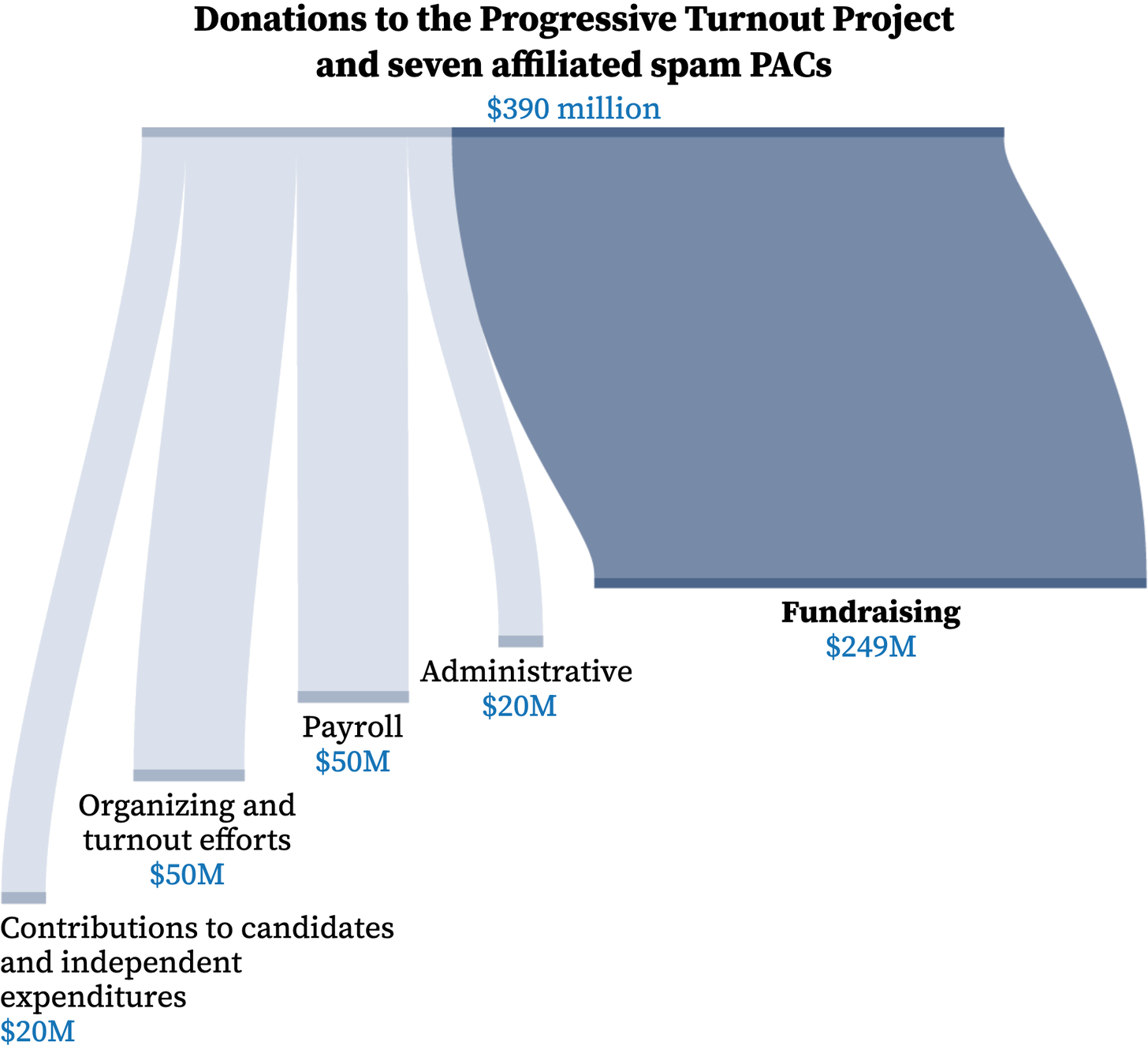
The Progressive Turnout Project declined to comment on the record, but in a letter, its lawyers claimed the group spent $177 million on fundraising — $72 million less than my estimate — and directed more than half its budget to voter contact. That discrepancy comes down to labeling: roughly $48 million of the difference was spent on Facebook ads that PTP categorized as “digital organizing,” but which function almost uniformly as fundraising solicitations. Other payments went directly to firms specializing in high-volume donor solicitation. Even by PTP’s own accounting, fundraising consumed roughly 45 cents of every dollar raised. Harry Pascal did not respond to a request for comment.
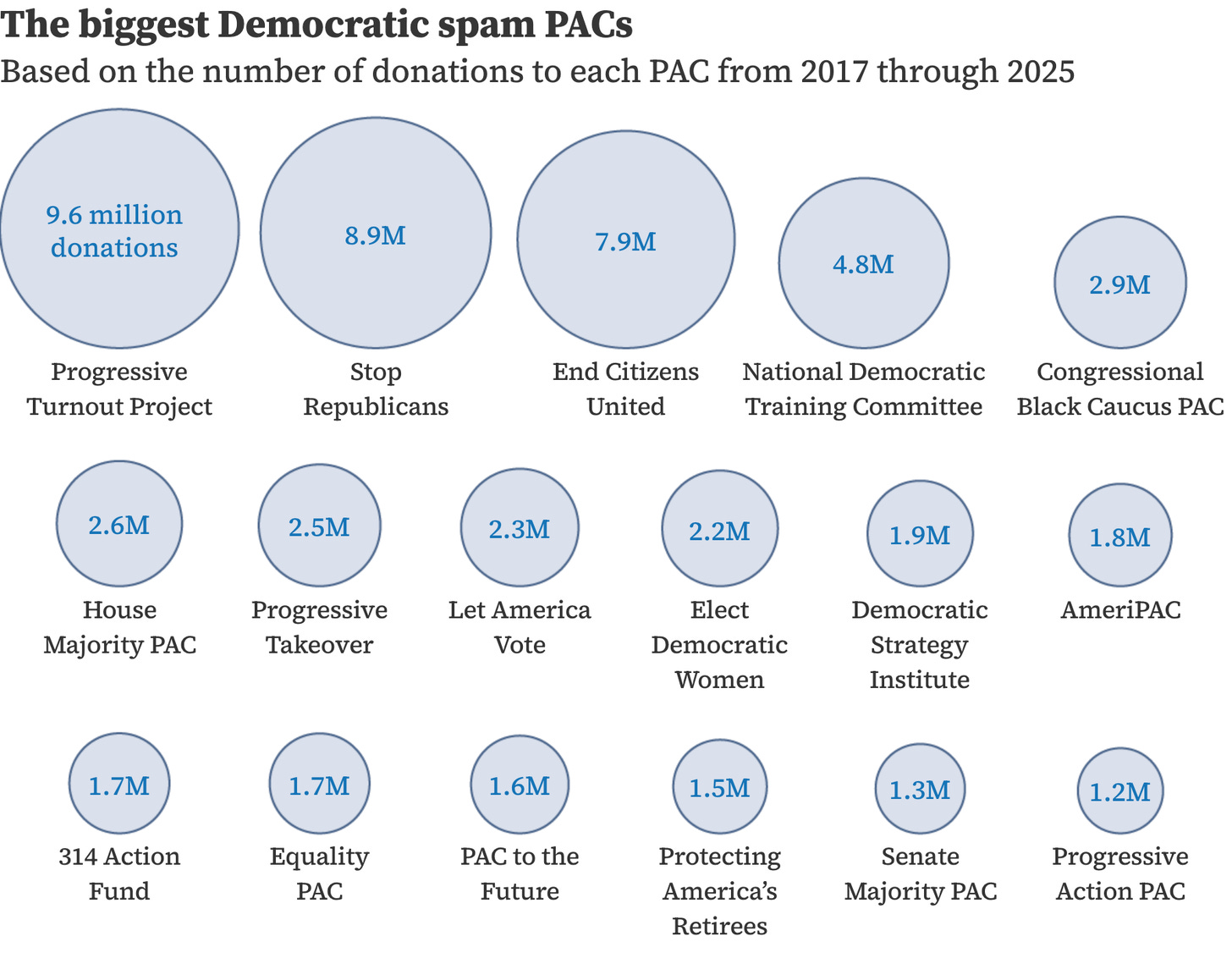
The Pascal network is just one large piece of a much larger phenomenon. I identified 145 Democratic-aligned spam PACs. Based on my analysis, these PACs share a common profile: heavy reliance on high-volume digital fundraising vendors, fundraising costs that consume a disproportionate share of what they raise, and a donor pool that skews overwhelmingly elderly, even compared to other PACs. More than that, they draw on the same concentrated, overlapping population — people like the 85-year-old in Oxford, Ohio, and the 91-year-old in Indianapolis.
Meta’s ad library gives us a sense of whom these ads reach. Among the fundraising ads run by the largest spam PACs, between 70 and 85 percent of impressions are delivered to users 65 and older, though people in that age band account for just 14 percent of Meta’s adult users in the United States, according to data published by Meta.4
The FEC donation records, cross-referenced with the L2 national voter file, reveal a similar but even more pronounced skew. Less than 1 percent of all Democratic donors account for almost half of the $1.4 billion raised by spam PACs since 2017. Put more precisely, roughly 138,000 donors averaging 75 years of age have each donated to these PACs one hundred times or more. I call them “captive spam donors.”
These PACs don’t “churn and burn” through disposable donors, as the model is often described. Rather, they hook and squeeze.
The groups behind these operations insist they do not target appeals by age. Mothership Strategies declined to comment on the record, but its lawyers argued in a letter that the age skew is natural rather than engineered: “Older Americans are more politically engaged, more likely to vote, more likely to be registered, and more financially capable of making charitable and political contributions than younger demographics.” Mothership further claimed that my methodology produced “unreliable age estimates.” Yet to support its defense that donors naturally skew older, the letter cited a study I published with Jake Grumbach that uses the very methodology it had just dismissed. That study found that the median donor to any candidate in the 2020 election was 59 years old. Donors to spam PACs run far older than political donors in general, with the captive donor pool averaging 75.
But who receives fundraising spam matters less than who responds. The same appeal can land in a million inboxes and still draw its money from a narrow, vulnerable few. No age filter is required at the sending end when the message does its sorting at the receiving end. Whether or not anyone set out to target the elderly, the sorting happens either way.
Whether or not those who operate this fundraising model recognize or intend it, fundraising spam runs on similar psychological levers to those that federal law enforcement and consumer-protection groups identify as hallmarks of elder financial exploitation: manufactured urgency, emotional appeals engineered to trigger guilt or fear, false exclusivity, fabricated account or profile statuses that look like official notices, and relentless pressure to give before there’s time to think. Why stamp “FINAL ATTEMPT” on a message and warn that “the deadline is just hours away” if not to manufacture urgency? Why claim that Barack Obama, Nancy Pelosi, and Hakeem Jeffries have emailed you, then demand an answer to their “desperate pleas” if not to trigger guilt? Why warn that Social Security checks will be “SLASHED by $500/month?!” — up from the $460 in the email sent two days earlier — if not to stoke fear? Why tell someone they are “the only Democrat in your city who hasn’t responded” if not to single them out? Why announce a recipient’s “appointment to the Social Security Advisory Board” above a picture of a Social Security card if not to dress a solicitation as official business? Why the midnight deadlines, the countdown timers, the “400% MATCH” that applies only if you give right now, if not to force a decision before reflection can intervene?
Even someone with no moral objection to these tactics should mind their cost. They poison the entire Democratic ecosystem, warping incentives for organizations and candidates alike. For campaigns, the draw is fundraising without the traditional work of fundraising — no grueling hours dialing for dollars, no donor dinners, no need to build genuine grassroots enthusiasm. Simply hire a digital firm and let the consultants tap into the pipeline.
Only about 20 percent of Democratic congressional candidates hire the high-volume digital fundraising firms used by spam PACs. But those candidates raised a combined $570 million from captive spam donors. The remaining 80 percent of Democratic candidates who stayed outside the spam ecosystem raised just $37 million from these donors.
Consider Jordan Wood’s abbreviated campaign for Senate last year. Wood had never held elective office and was polling in the single digits, but his Senate primary campaign in Maine raised nearly $4 million before he withdrew in November 2025 to run for a U.S. House seat. His campaign paid Sapphire Strategies — a Mothership competitor that services several of the largest spam PACs — more than $2 million for fundraising and consulting. Sapphire’s digital messaging tapped directly into the captive spam donor pool, producing a donor base nearly indistinguishable from that of spam PACs. Wood was steeped in the ecosystem before launching his campaign: He is the former vice president of End Citizens United, the co-founder and former executive director of DemocracyFirst (a spam PAC for which Harry Pascal now serves as treasurer), and the husband of a Mothership co-founder. What looked like grassroots enthusiasm was actually a vendor-driven pipeline funneling money from captive donors to the candidates willing to pay to spam them.
When asked for comment, a spokesman for the Wood campaign responded by noting his narrow loss in the House primary.
Sapphire Strategies declined to comment on the record.
Defenders justify the model with one claim: It works. Federal records show this is a half-truth, and a troubling one at that. In the fall of 2025, when Paul Rivera — tasked with writing the DNC’s 2024 post-election autopsy report — asked me to estimate how much Democrats now spend to raise a single dollar, my analysis of the data revealed a profound collapse in fundraising efficiency. The share of campaign dollars consumed by fundraising costs had ballooned from 8 cents per dollar in 2008 to more than 50 cents by 2024. Spam operations make up a growing share of that spending, and are especially inefficient. In 2025, they consumed between 70 and 75 cents of every dollar they raised.
But the most devastating result of this strategy doesn’t show up on an FEC report. In exchange for a quick return today, fundraising consultants are liquidating the party’s long-term future, turning potential lifelong donors into people who now delete Democratic messages on sight. Every frantic appeal trains donors to see the party as desperate and unserious. What respectable organization treats its supporters this way and expects to keep them? In the long run, these tactics are less a boon to the party’s finances than a siphon.
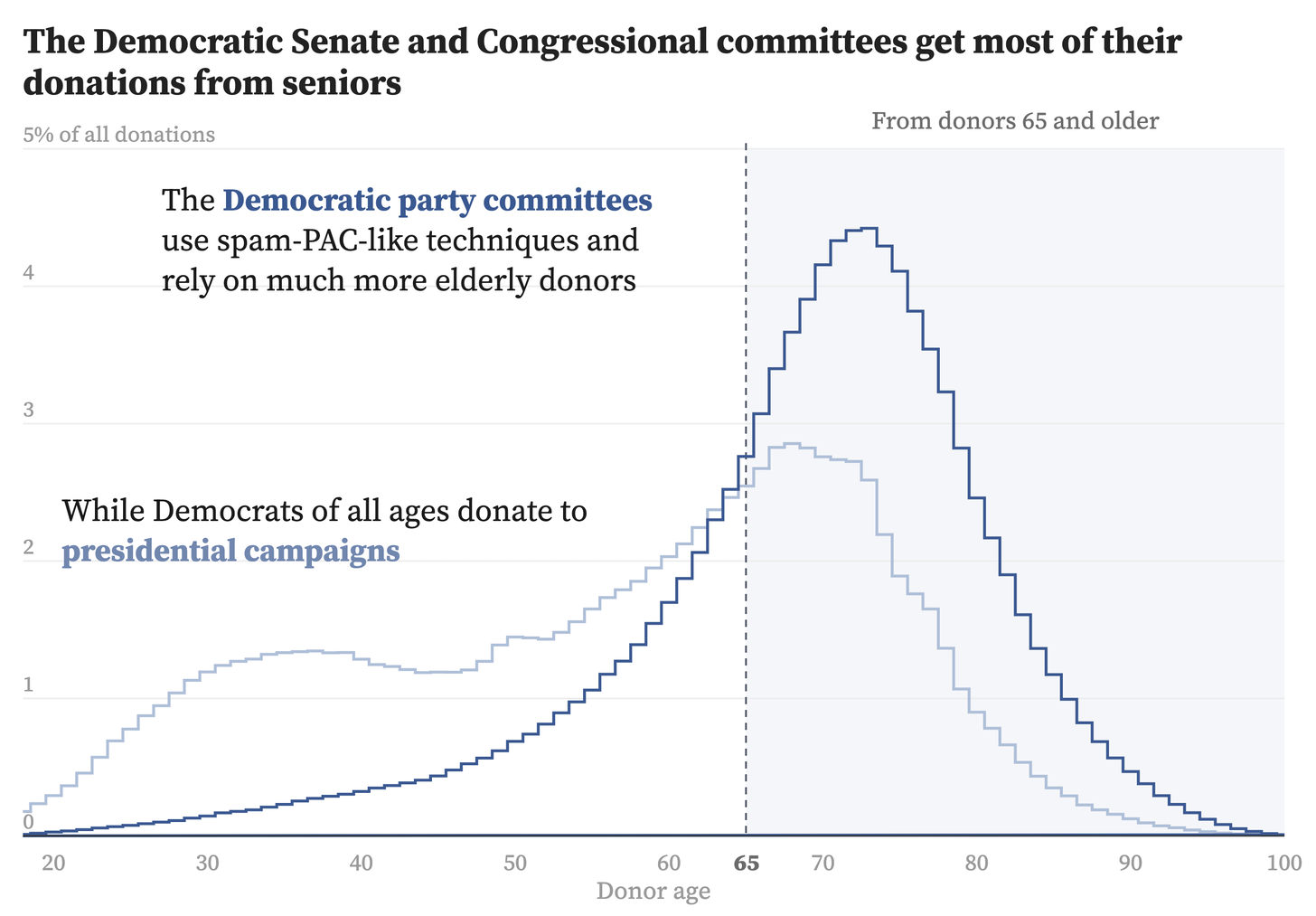
The party’s platform champions protecting the vulnerable. Its fundraising apparatus exploits them. The party’s official campaign committees, which should set the standard, are instead some of the worst offenders. Emails and texts from the DCCC and the DSCC feature similarly aggressive fundraising pleas and draw heavily from captive spam donors.
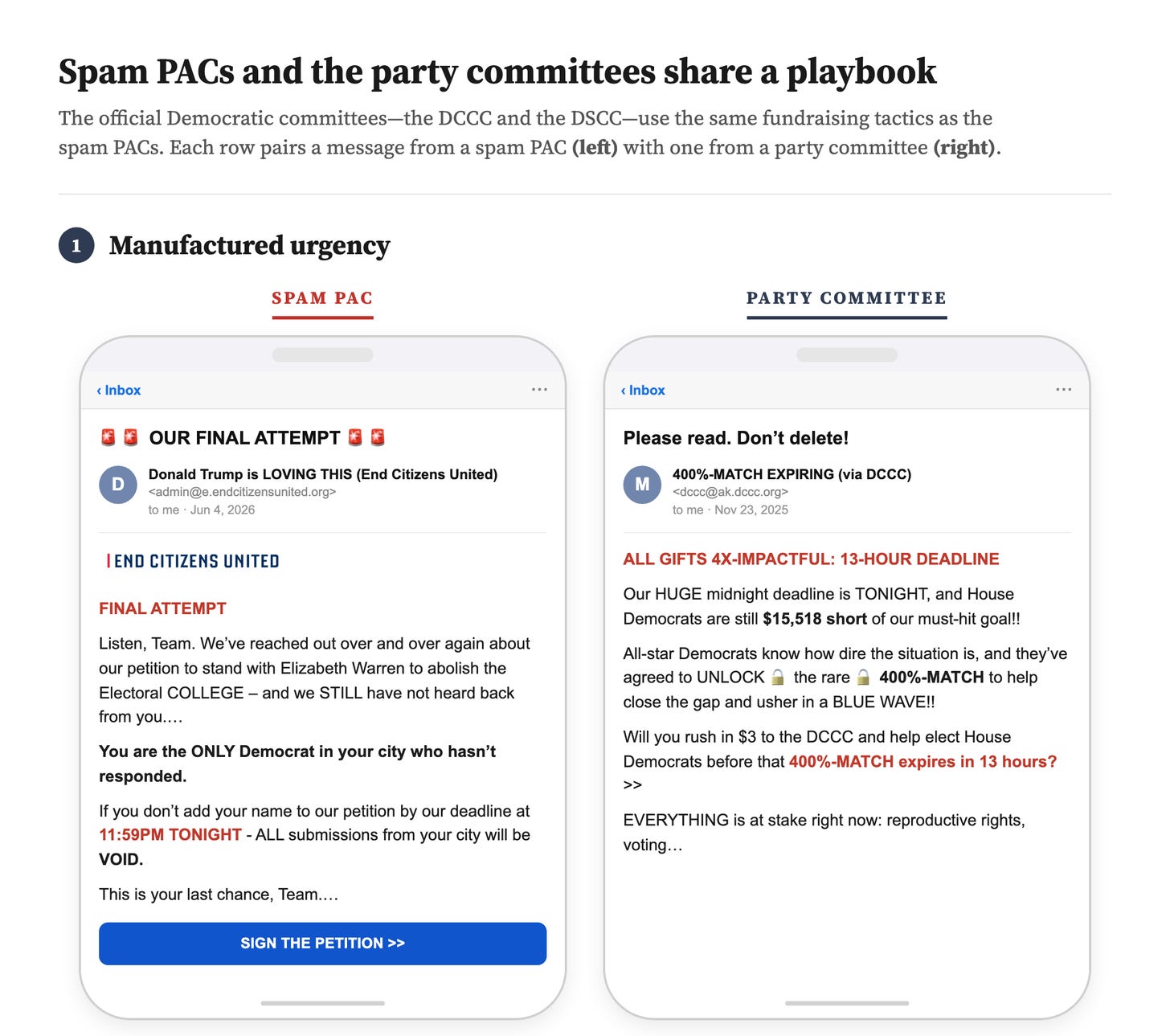
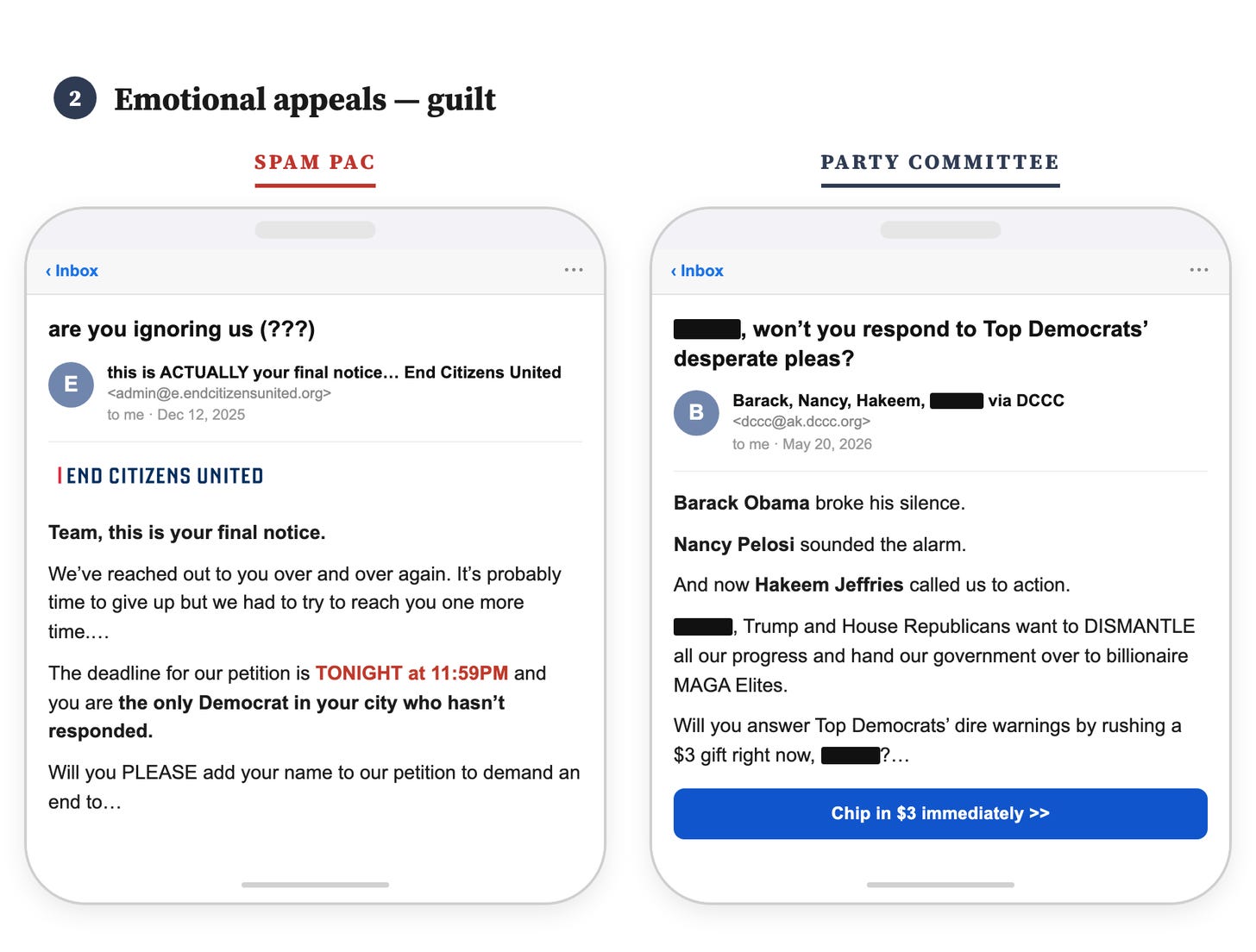
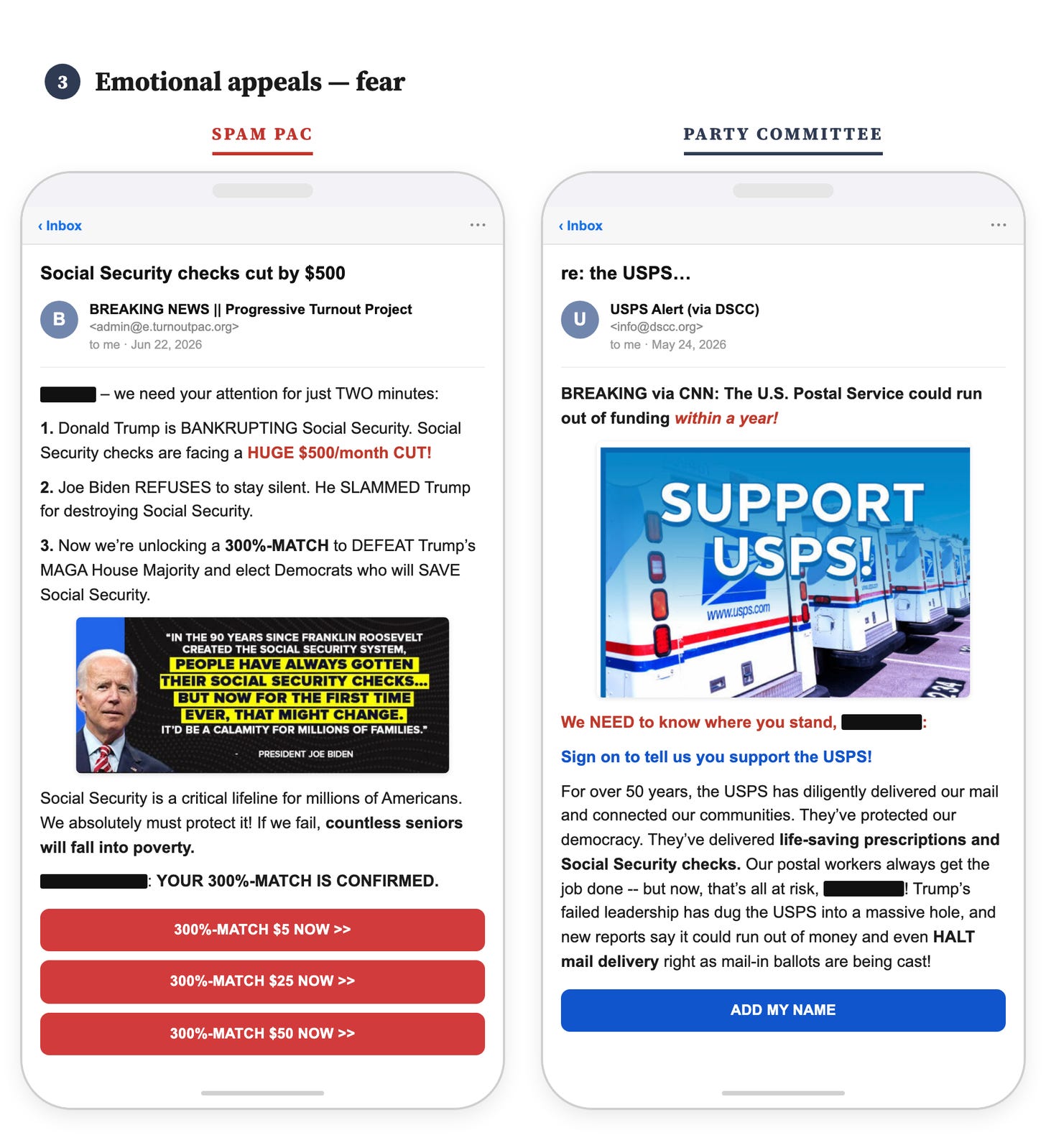
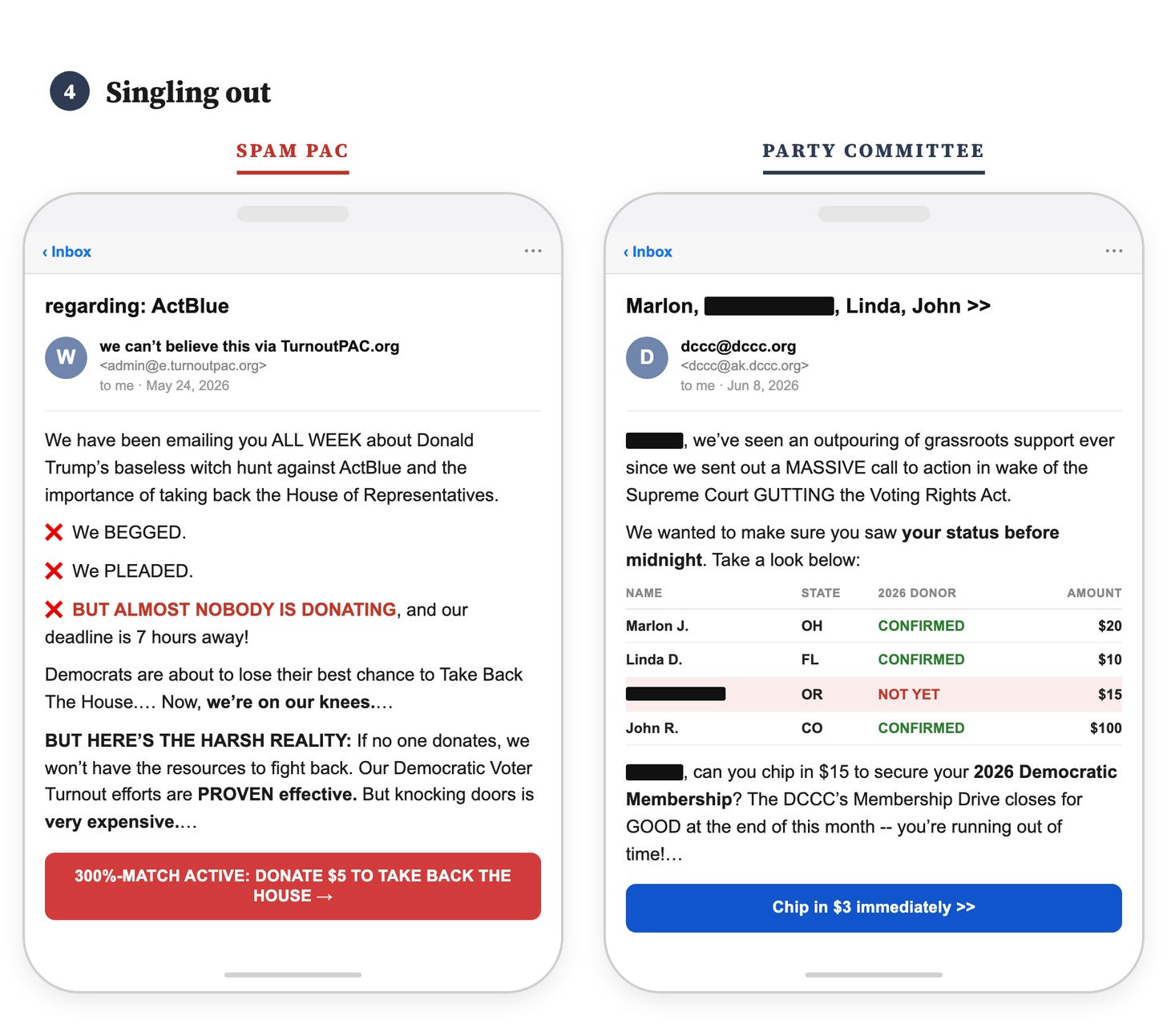
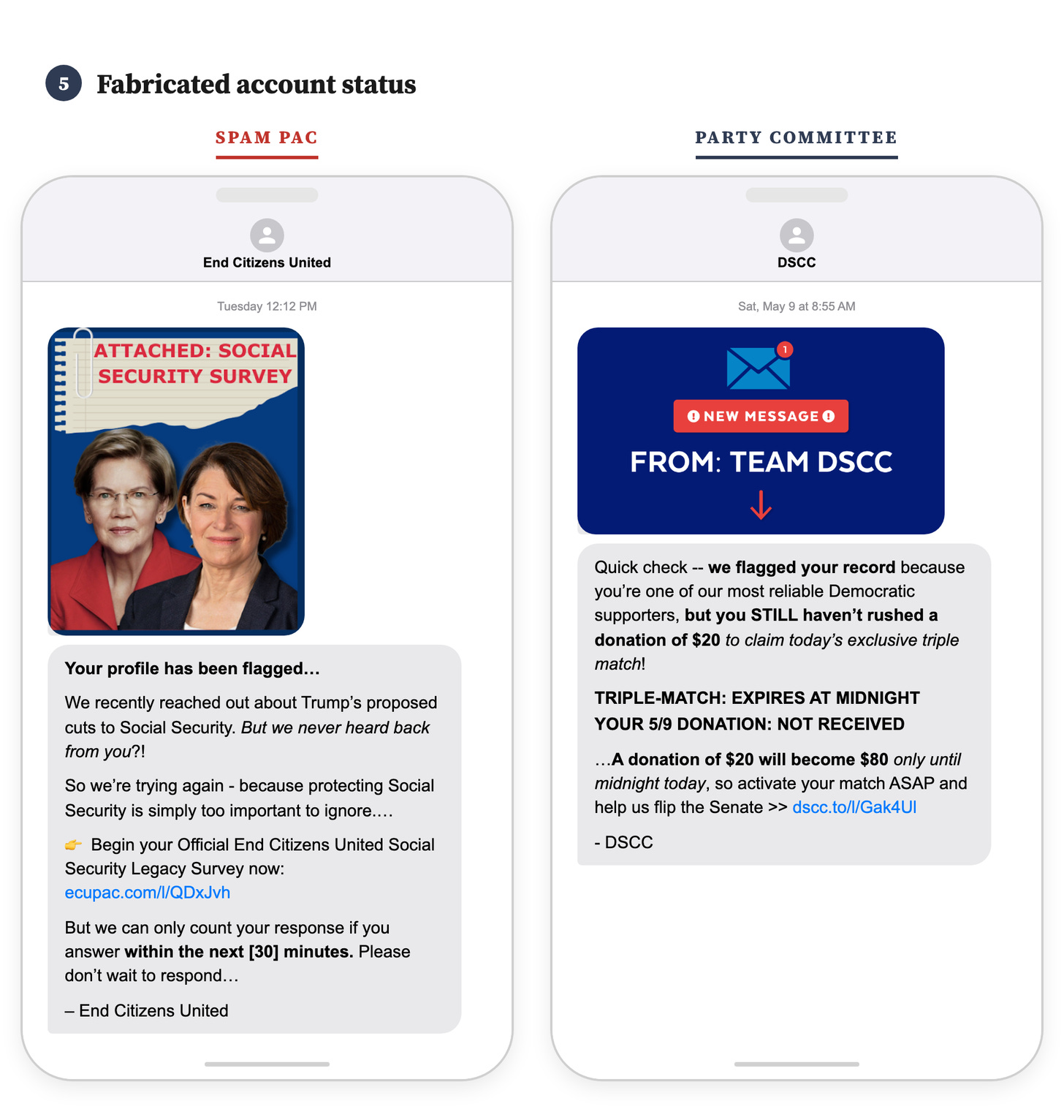
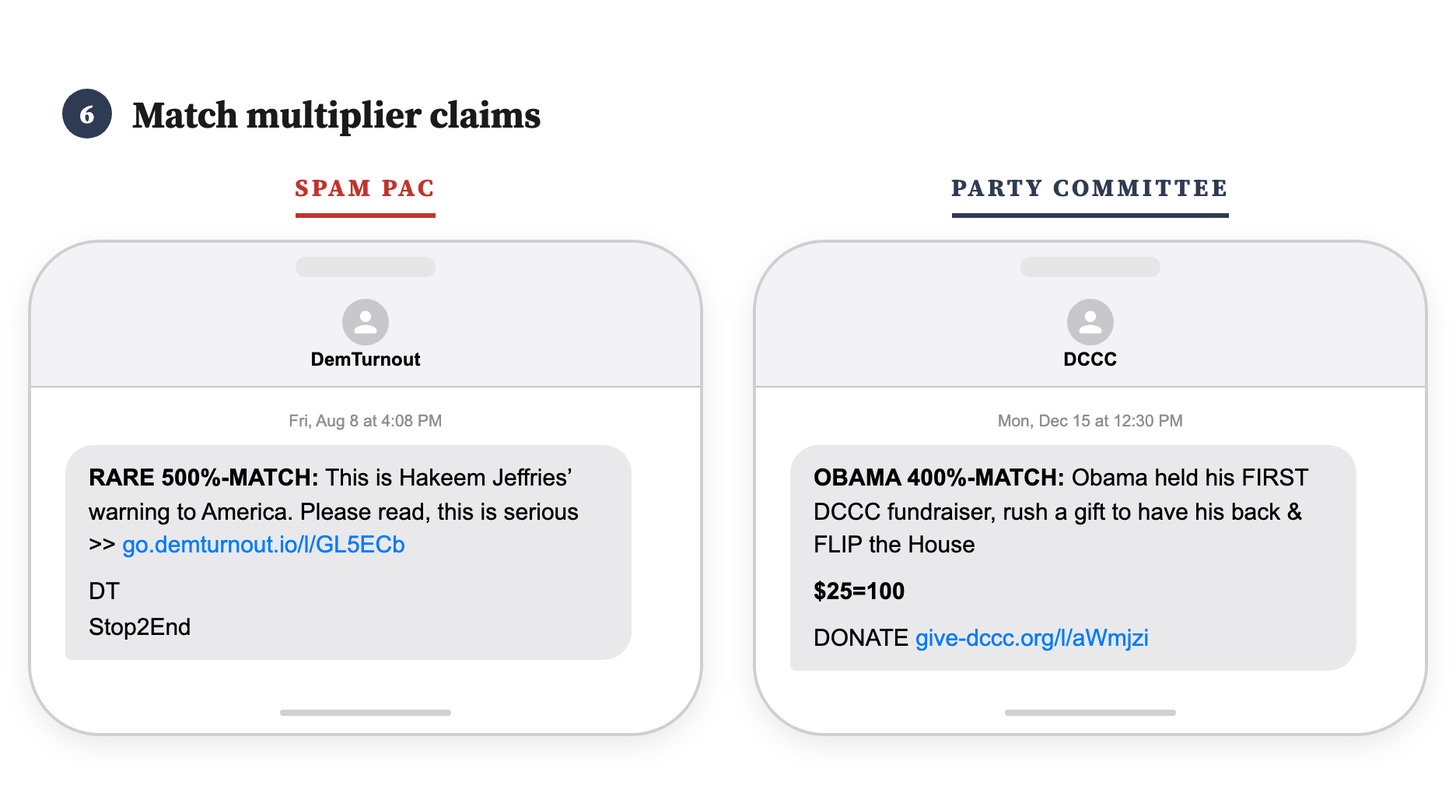
Neither the DCCC nor the DSCC agreed to comment on the record for this article. Instead, when this reporting was scheduled for publication at The New York Times, the Elias Law Group — representing both committees — wrote to the paper’s deputy general counsel demanding it “cease and desist from publishing.” The letter stated that “the Committees do not ‘target’ their email and texting solicitations to the elderly. In fact, neither Committee has the technology or data to do so.” This piece makes no claim that either committee targets donor solicitations by age; the finding concerns who responds, not whom it is aimed at. The letter further objected to my standing: “the Times must know that Mr. Bonica — as an outside observer with no knowledge of the Committees’ processes — has no basis whatsoever to make this claim.” After months of delay following the legal demand, the paper decided not to proceed with publication.
A spokesperson for The Times declined to comment on the specifics of the cease-and-desist letter or its internal deliberations, offering a statement that said in part: “It is not unusual for these projects to fail to reach the publication stage, even after deliberation and editing,” adding that the paper does not “refrain from publishing vetted and important pieces of journalism simply because outside parties express disagreement with them.” The statement did not identify any factual errors in the investigation or dispute receiving the legal demand from the committees’ counsel.
The party’s standard-bearers have a responsibility for reconciling the difference between their stated values and their fundraising practices. As the leader of House Democrats — and the person who appoints the DCCC’s leadership and drives its strategy — Hakeem Jeffries is uniquely positioned to either dismantle the spam machine or own its consequences.
Since he became House minority leader, Hakeem Jeffries’s principal campaign committee has raised $14 million from donors who gave less than $200, trailing only Alexandria Ocasio-Cortez among House Democrats. On its face, this suggests broad grassroots appeal. But 93 percent of those donations come from donors who have also given to spam PACs, and nearly 40 percent are from captive spam donors — people whose donation history shows one hundred or more charges from spam PACs. During the same period, his campaign paid more than $6 million to Sapphire Strategies for digital fundraising and advertising. His joint fundraising committee, Defend the Vote Leadership Fund, is a Mothership client, according to FEC filings. Jeffries’s fundraising operation fishes from the same pool with the same bait.
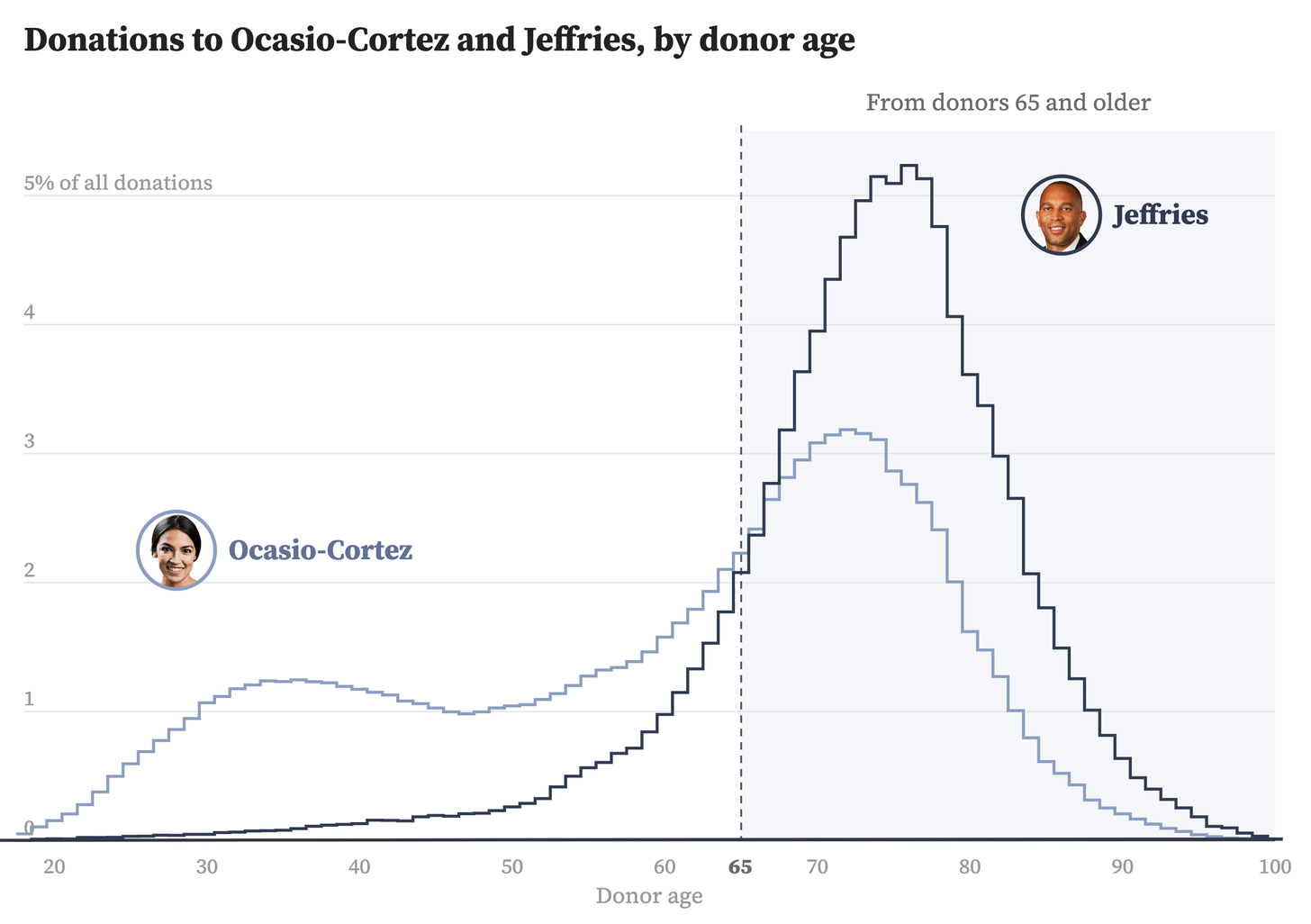
In the 2018 election cycle, Jeffries had one of the youngest donor bases of any House Democrat, with an average donor age of 54 and only 21 percent of his donors 65 or older. When he became caucus chair in 2019, those numbers began to shift. By the 2026 election cycle, his average donor was 73, and 86 percent were 65 or older. Jeffries didn’t change his political positions in ways that would account for this shift; it was his role in the party that changed — and his fundraising strategy.
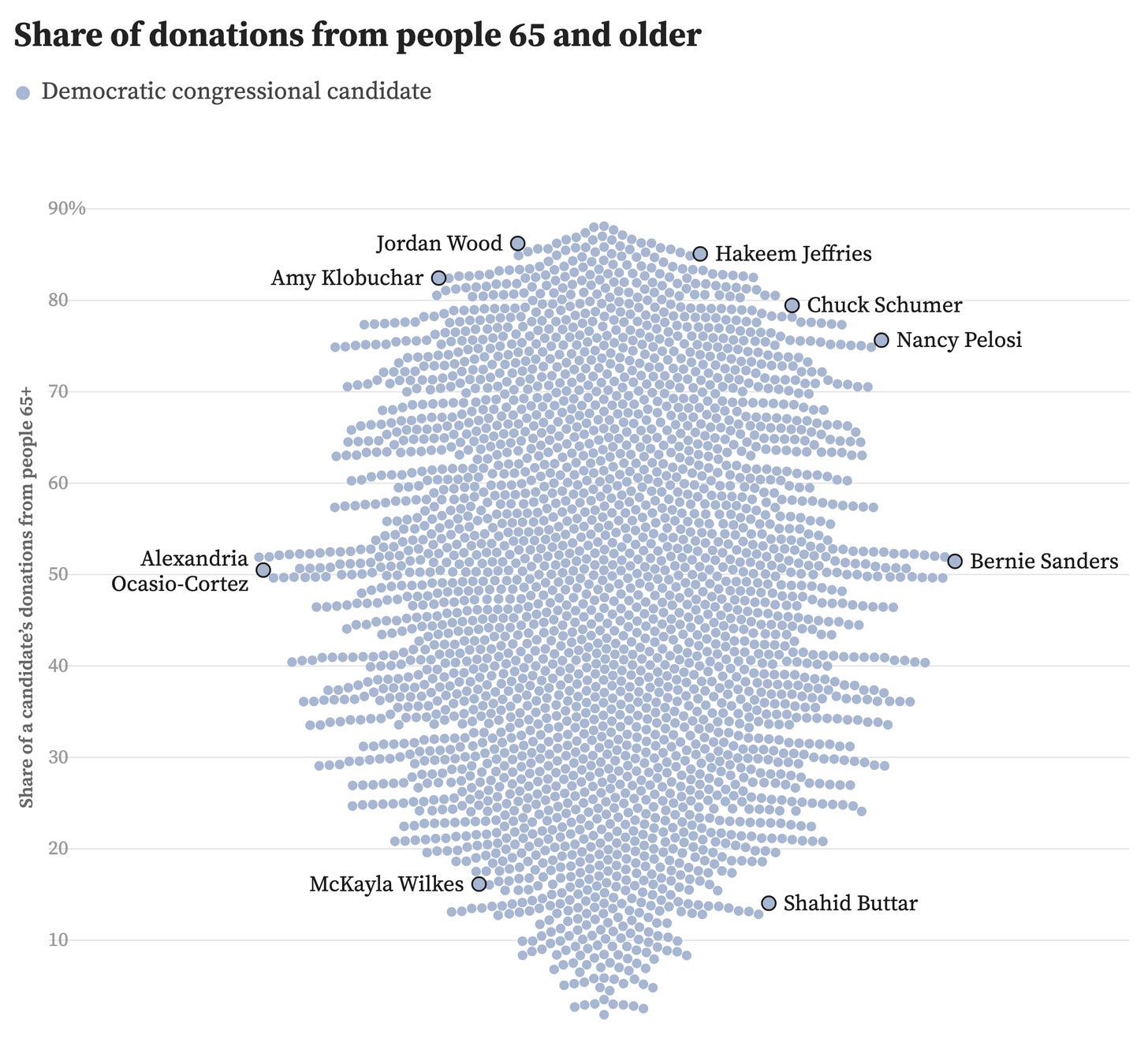
The pattern extends to Jeffries’s fundraising advertising. Last year, his Instagram and Facebook ads reached a higher share of senior citizens than those of 94 percent of Democratic House candidates, according to Meta’s public ad library. Jeffries’s office declined to comment on the record.
This fundraising model is a parasite on the party, enriching outside consultants while steadily starving the host. Republicans succumbed to it first, watching their own grassroots donor base hollow out in real time. If Democrats don’t change course, they are headed into the exact same donor death spiral.
The good news is that change is possible. After I published a series of articles on Substack last summer about deceptive fundraising practices, ActBlue leadership reached out to me to discuss the platform’s response. Soon after, ActBlue announced its most significant crackdown on deceptive fundraising to date, explicitly forbidding the impersonation of candidates and unverified matching donations. There has been other movement in the right direction. The Democratic National Committee, led by Ken Martin, launched an effort to stop PACs from trading on the Democratic name without actually supporting Democratic candidates.
But these reforms have not been enough. In the four months after ActBlue’s crackdown, donations to spam PACs were up 33 percent from the same period in 2023, the most recent comparable non-election year. The same vendors are still getting paid. Elderly donors are still being squeezed. Fifty-eight new Democratic PACs that meet my criteria for spam PAC behavior have begun raising money since the 2024 election. In 2025 alone, Democratic-aligned spam PACs raised more from individual donors than all Democratic Senate candidates combined.
Jeffries inherited this cursed fundraising model from his predecessors, and he is far from the only Democrat caught up in it. The system persists because every individual candidate and organization faces the same calculation: The candidates who opt-out risk falling behind those who opt-in. The result is that the donors being squeezed are elderly, while younger Democrats are being driven away. And the digital consultants profit whether the party wins or loses.
The cycle will not break until a leader with the authority to change the system chooses to confront it rather than participate in it. In this moment of political renewal for the Democratic Party, Jeffries should step forward and show leadership by cutting ties with the consultants and committees that profit from fundraising spam. The authority to blacklist vendors who prey on elderly donors is his. So is the choice not to.
A political movement requires more than money — it requires trust. Every dollar extracted through these tactics is a withdrawal from that trust. The Democrats’ account is now dangerously overdrawn.
The investigation above tells the story of an industry profiting off vulnerable donors. The challenge I faced in publishing it became a story on its own. Political scientists teach that power works best when it never has to be exercised in public. In the coming weeks, I’ll tell that story through the lens of someone who studies how power operates in politics and law. It’s a story about journalism that most journalists aren’t in a position to tell, and one about why reform keeps stalling.
Methodology and Replication Archive
The author’s analysis drew from three primary data sources: individual contribution records from the Federal Election Commission covering over 300 million donations from 2017 through 2025; the L2 national voter file, used to estimate donor ages by matching contributor records to voter registration data; and Meta’s public advertising library, which provides demographic reach data for political ads on Facebook and Instagram.
The process for obtaining donor ages through record linkage is described in “Old Money: Campaign Finance and Gerontocracy in the United States,” published in the Journal of Public Economics in 2025.
Spam PACs were identified based on an examination of public FEC filings, analyzing both how these committees raised money and how they spent it. On the fundraising side, the author considered reliance on vendors specializing in high-volume digital fundraising, concentration of donors aged 65 and older, and dependence on a core population of hyper-frequent donors exhibiting unusual donation patterns, including hundreds or thousands of contributions concentrated among PACs with high-volume fundraising models. On the spending side, the author examined fundraising costs relative to total receipts from individuals. These classifications were validated against a collection of fundraising texts and emails to confirm that the spam PACs employed the high-pressure tactics described in this essay. The classifications were further validated using principal component analysis, a standard statistical technique for identifying structural patterns in data. Party committees and candidates were excluded from the spam PAC classification but analyzed separately using the same indicators.
Expenditure categories for the Pascal network were classified using an algorithm developed by the author to code PAC and candidate disbursements from FEC filings, with additional manual review.
The data and code used in this analysis are available via GitHub as a public replication archive.
The record-linkage methodology used to estimate donor ages is described in “Old Money: Campaign Finance and Gerontocracy in the United States,” which I wrote with Jacob M. Grumbach and which was published in the Journal of Public Economics in 2025. The method matches FEC contributor records to the L2 national voter file. The vast majority of matches share both name and street address; less certain matches are weighted less heavily, minimizing the impact of false positives. Robustness checks reported in the paper show that measurement error is minimal, and the identical linkage procedure was applied to every PAC and candidate analyzed, so comparisons across committees rest on a consistent measure.
When challenged, these organizations often protest that they are not “scam PACs” — a term commonly applied to committees that divert contributions into personal pockets or phantom vendors without supporting candidates. While the scam label describes how a PAC misuses its money, the spam label used here describes how a PAC raises it: by deploying deceptive, high-pressure digital solicitations that extract funds primarily to finance further solicitation.
Categorizing FEC expenditures inherently involves some discretion. Organizations self-report the purpose of each disbursement, and the vocabulary is not standardized: the same vendor providing the same service might be described in FEC filings as “fundraising,” “digital advertising,” “digital advocacy,” and “digital organizing.” I counted as fundraising all the payments to firms whose core business is fundraising, along with the direct costs of soliciting and processing donations. Ambiguous line items were coded in the PACs’ favor — printing, postage, staffing, and anything plausibly related to voter contact all counted as organizing — so, if anything, these figures likely understate fundraising costs. The full classification of more than 50,000 line items, with notes explaining every coding decision that departs from a reported purpose, is available in the replication archive.
Every time an ad is displayed to a user, that’s one impression.
This is a terrific article. Democratic Party leaders need to step up to stop the extraordinary damage done to the party by the fundraising tactics Adam describes. In addition to the problem with Spam,,gross inefficiency, and taking advantage of seniors, there is a complete lack of accountability. PACs are only required to report to the FEC who is their treasurer, who is often someone from a compliance firm that only files the FEC reports. There is no requirement of disclosure of the people who started the PAC, or who is leading the PAC and making decisions about its fundraising and spending. So there is a complete lack of accountability, despite the legal concept that all federal political spending must be reported to the FEC. Legislation to require PAC initiators and decision-makers to be disclosed should be a Democratic Party priority. In addition, the DNC and candidates should adopt a strong fundraising Code of Conduct that vendors and consultants are required to follow as a condition of being hired. With the money that is currently being siphoned off by fundraisers and consultants, we could throw MAGA out of power for good.
Could you please recommend specific actions we should take (including specific language we can use) to hold the party accountable for this and demand change?