

The Fundraising-Industrial Complex Is Eating American Politics
New data reveals campaigns burn about a third of donations raised just asking for more donations

In 2004, political campaigns spent 9 cents of every dollar raised on fundraising operations. By 2024, that number had reached 30 cents. American political campaigns are raising more and more money less and less efficiently. I’ve analyzed data from FEC disbursement records, using an algorithm I developed to classify expenditures by spending category. It reveals that campaigns are now spending 38 cents of every dollar raised just to raise more money—a fourfold increase from the 9 cents spent in 2004. In raw terms, campaigns burned through $3 billion on fundraising operations in 2024 alone.
This represents a fundamental shift in how political money flows through our democracy. Twenty years ago, fundraising operations were a necessary but modest expense, like renting office space or printing yard signs. Today, it has metastasized into the primary activity of most campaigns. In 2022, 31% of total expenditures were for fundraising expenses. This came close to exceeding the 33% of total expenditures going towards advertising. If current trends hold in 2026, it’s likely that fundraising costs will for the first time exceed what is spent on advertising, thus becoming the biggest spending category.

This inefficiency is partly fueled by an arms race between the parties. While Republicans have historically spent more as a percentage on fundraising operations than Democrats, Democrats are rapidly closing the gap.
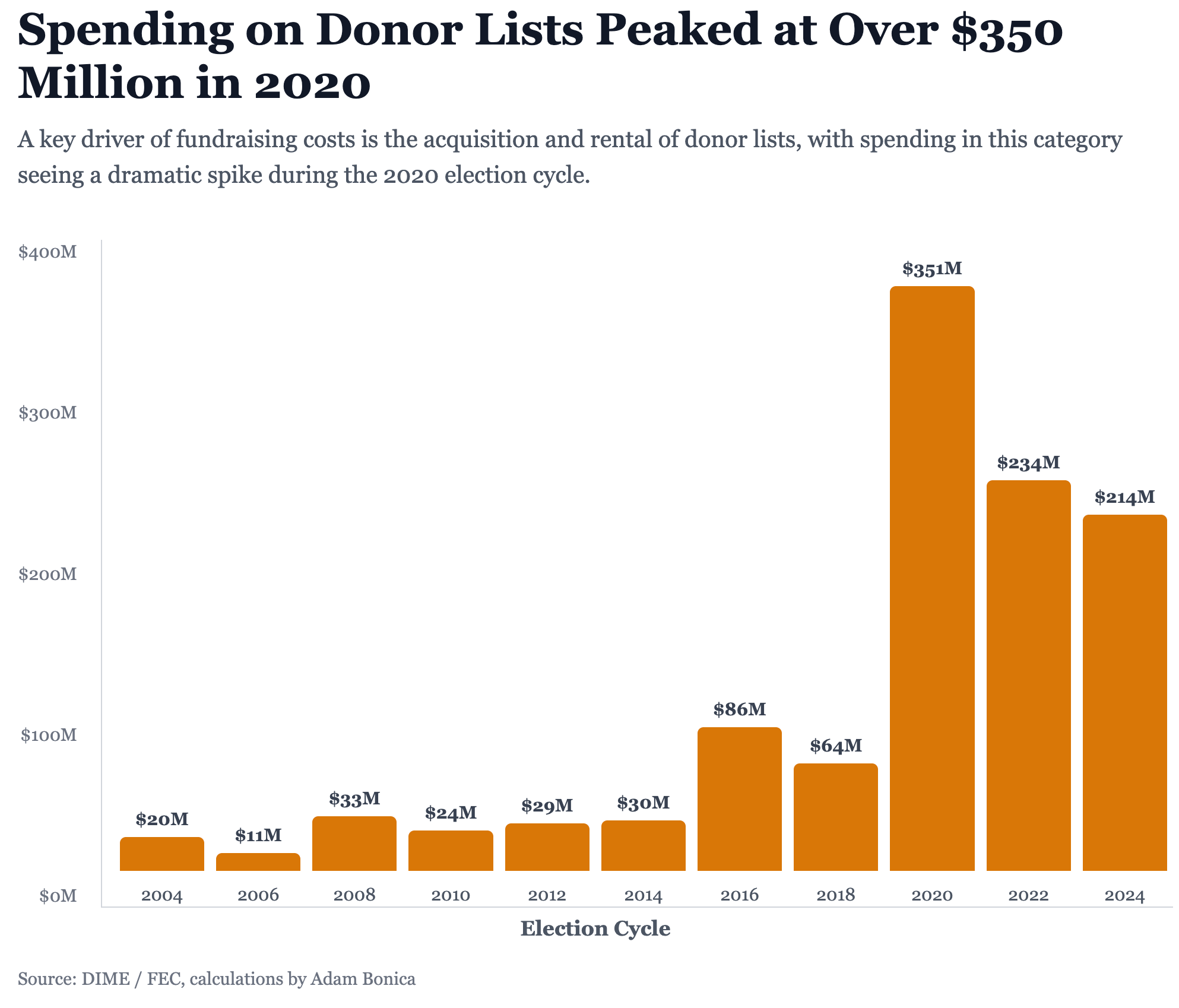
The mechanics behind growing fundraising are telling. Spending on donor lists exploded from $20 million in 2004 to $351 million in 2020 before settling at $214 million in 2024. Campaigns now pay large sums just to acquire the contact information of people they can bombard with donation requests. Once a campaign buys your name, they monetize it by reselling it to other campaigns, creating a cycle of solicitation that enriches list brokers while exhausting donors.
This data validates what every politically engaged American already knows from their overflowing inboxes and buzzing phones: the fundraising industrial complex has become a parasite on the democratic process. When nearly one-third of all political contributions get recycled back into asking for more contributions, we've created a system that exists primarily to perpetuate itself while enriching fundraising consultants.
Every dollar spent on fundraising consultants, list rentals, and SMS spammers is a dollar not spent on voter contact, organizing, or actual political communication. Campaigns that should be building movements are instead building donor databases. Political energy that could mobilize communities gets redirected into optimizing email subject lines and testing which desperate plea extracts the most dollars from exhausted supporters.
This isn't how a healthy democracy functions. When the mechanics of fundraising consume the mission of politics, when raising money becomes more important than the cause it's supposed to fund, we've lost the plot. Fundraising shouldn’t be the end goal. But it is increasingly difficult to escape the conclusion that too many candidates and party operatives have mistaken it for one.
Thank you for sharing!
Any chance you can share the code behind this analysis, like you did with your original Mothership article?
Thanks for this, I finally understand the snowstorm of hysterical emails I'm getting from democratic orgs I've never heard of. But I'm wondering about the ones--many--that asked me to sign a petition. Is this a useful or serious petition or is it just a way to get me to the donate page? After all, the ACLU also asks me to sign petitions, and then the petition leads me to the donate page. And I do take the ACLU more seriously - or is that a mistake?