

Why America’s Government Shutdowns Exist and How to End Them
One Legal Memo Created The Shutdown Era. Another Can End It.

More than a month into this government shutdown, there seems to be no end in sight. It’s just another broken feature of American democracy that we’ve come to accept as normal.
Except it’s not. We’re the only major democracy that does this to itself.
I’ve been teaching American political institutions for the past 15 years. Almost without fail, at some point during the quarter the federal government either shuts down or comes to the brink of doing so. Each year another budget crisis. Each year I’d explain to students how other countries have actual safeguards. In parliamentary systems, a failed budget might trigger new elections. Others automatically continue funding at previous levels. Government shutdowns are yet another anomalous feature of American political institutions that we accept as unavoidable when it is anything but.
Government shutdowns aren’t required by the Constitution or any Supreme Court ruling. They arose from a Justice Department memo that reinterpreted the Antideficiency Act—a 19th-century law that limits obligations without appropriations—nearly a century after the legislation was enacted.
Before 1980, shutdowns didn’t happen. When funding gaps occurred, federal agencies kept operating. The understanding was straightforward: Congress would eventually pass the funding, everyone would get paid, and life would go on. Budget negotiations did not routinely devolve into national crises.
Then came the memo. In 1980, the Justice Department’s Office of Legal Counsel issued a new interpretation of the Antideficiency Act. Beginning with Attorney General Benjamin Civiletti, the OLC concluded that this old statute required most government operations to cease the moment appropriations lapsed. OLC lawyers offered their opinion on how things should work and everyone just sort of went along with it.
It may not have been clear at the time, but it turned federal employees’ livelihoods into bargaining chips. Every shutdown means hundreds of thousands of public servants—people who chose careers in public service—face mortgage payments without paychecks, childcare costs without income, and the grinding uncertainty of not knowing when normalcy will return. Their families plan around salaries that suddenly vanish for reasons that have nothing to do with their work or performance. This is beyond counterproductive. It’s outright disrespectful of the people who keep our government running. And this is to say nothing of the needless cruelty inflicted on millions of working families that depend on SNAP and other government services.
What Was Created by Memo Can Be Undone by Memo
Fixing this problem doesn’t require a constitutional amendment, a new statute, or some grand bipartisan bargain. It requires a new Attorney General to issue a new legal opinion.
It’s the rare institutional problem with a straightforward institutional solution. And any presidential candidate can make this commitment on the campaign trail: to direct their Attorney General to revisit the OLC memo upon taking office.
The next administration can move to end this recurring self-inflicted cycle of dysfunction with a single memorandum, which I’ve taken the liberty to draft a condensed version:
To: Heads of Executive Departments and Agencies
From: The Office of the Attorney General
Subject: [PROPOSED] Reconsideration of the Antideficiency Act During Lapsed Appropriations
This memorandum reconsiders and rescinds prior opinions (1980, 1981) concerning the Antideficiency Act (31 U.S.C. §§ 1341–1342) during periods when appropriations have lapsed. Those earlier opinions improperly concluded that the Act requires executive agencies to suspend nearly all operations.
We now conclude that the Antideficiency Act does not compel such cessation of ordinary government functions. The Act was intended to prevent agencies from obligating funds for programs Congress has not authorized, not to halt already-authorized programs during a temporary funding gap.
Therefore, agencies may lawfully continue ordinary operations when (1) Congress has duly authorized the underlying programs by law, and (2) operations are funded by permanent appropriations, multi-year appropriations, express statutory authorization to obligate in advance of appropriations, presidential constitutional authority, or activities necessarily implied from those authorized functions.
The Antideficiency Act was designed to stop agencies from spending money on programs Congress never authorized. It wasn’t meant to force government collapse because the next funding check for an already-authorized program is temporarily delayed by political dispute.
This memo returns us to the pre-1980 norm. It defuses the hostage situation. It transforms shutdowns from national crisis back to what they should be: mundane budget negotiations.
How Would This Affect Bargaining Dynamics?
Critics might worry that ending shutdowns would empower the President at Congress’ expense. The opposite is closer to the truth.
For nearly a century before 1980, the government continued operating during funding gaps without threatening the separation of powers. When Congress couldn’t agree on a budget, spending simply continued at current levels; the status quo became the fallback position rather than a government shutdown.
The current system creates what political scientists call a “reversion point” problem, best illustrated through Oregon’s experience with school funding. For decades, many Oregon school districts faced a cruel choice: voters could approve whatever budget the school board proposed, or funding would drop to catastrophically low levels, forcing schools to close. School boards learned to exploit this dynamic, proposing budgets far above what voters wanted, betting that voters would grudgingly approve rather than see their schools close.
Political scientists Romer and Rosenthal formalized this insight: when the fallback position is catastrophic, whoever controls the agenda gains enormous leverage. They can demand far more than in normal negotiations because the alternative is disaster. In Oregon, school boards could extract budgets well above what communities wanted because the alternative was no school at all. With federal shutdowns, the party more willing to accept governmental collapse—or whose priority agencies stay open during shutdowns—gains similar leverage.
More importantly, as the data shows, shutdown rules are strongly biased in favor of Republicans. This is why recent shutdowns have been due to Republicans in Congress, not presidential vetoes.
During shutdowns, agencies aligned with Democratic priorities face devastating furlough rates. Agencies that protect workers, enforce environmental laws, and provide social services are heavily affected. Agencies that Republicans like are mostly unaffected. Under the current shutdown rules, ICE can remain fully operational while the EPA is ground to a halt.
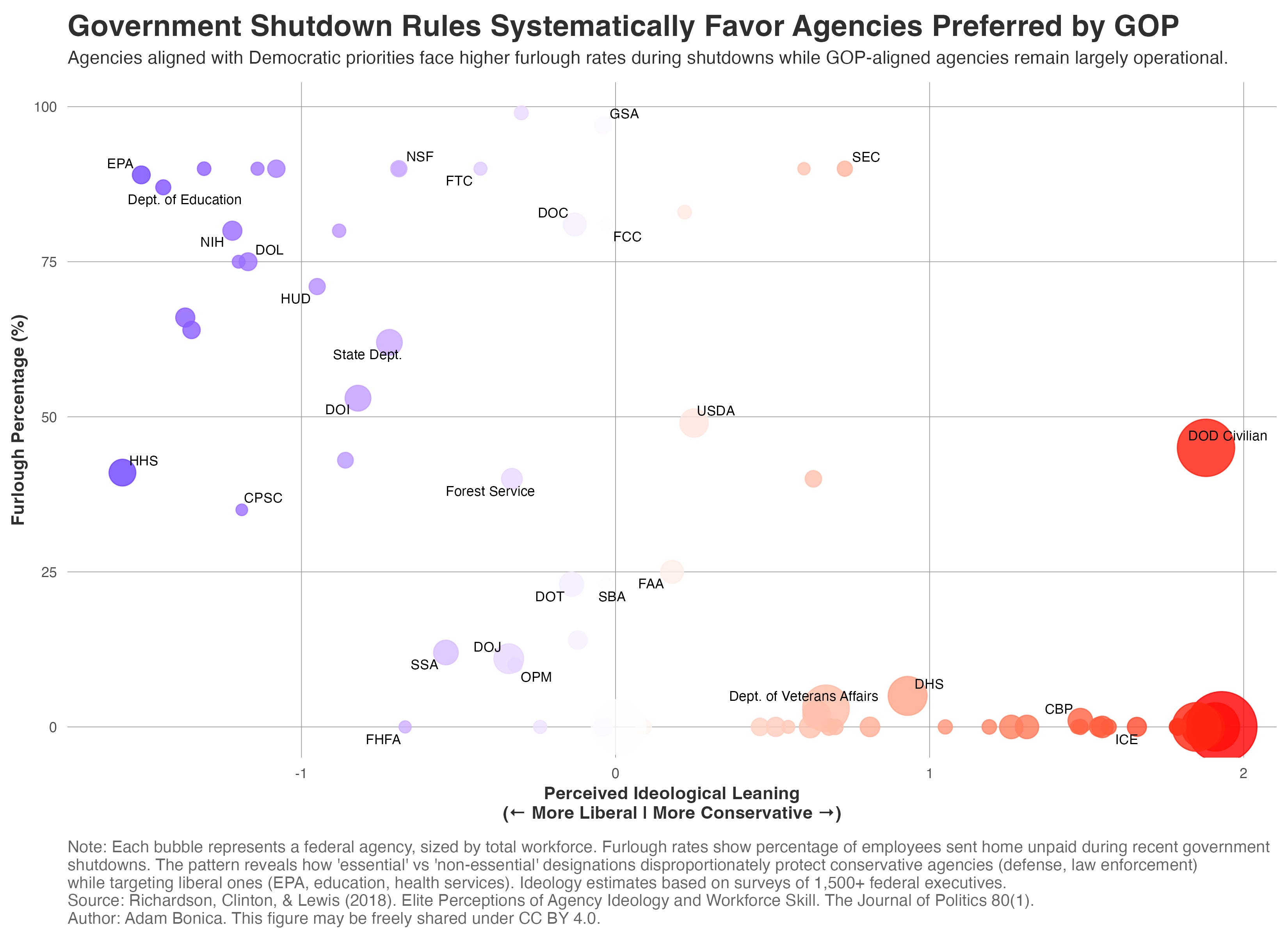
The party comfortable watching the government shutter holds all the cards. When your priorities stay funded while your opponent’s priorities collapse, why compromise?
The Political Reality: A One-Sided Problem
Congressional leaders might insist they need shutdowns as leverage—that without this threat, presidents won’t come to the table. This gets the recent history backwards. Nearly every shutdown in the past three decades stemmed from Congress’ own internal gridlock, its inability to send any bill to the president’s desk. These weren’t battles between Congress and the White House. They were congressional Republicans holding the government hostage to extract concessions they couldn’t win through normal legislation.
The current rules aren’t neutral. They’re a structural gift to the party that wants government to do less. Republicans keep their priorities funded during shutdowns while Democratic priorities—environmental protection, workplace safety, food assistance—get decimated. This asymmetry explains why Republicans consistently trigger these crises while Democrats scramble to end them. When the rules reward your side for creating chaos, why would you want to change them?
Democrats need to recognize this isn’t a shared problem requiring bipartisan solutions. It’s a systematic disadvantage they must fix when they have the power to do so. The next Democratic president should issue the corrective memo. No negotiation. No compromise. Just restore the system that worked for a century.
Political disagreement is a fixture of every democratic system. The problem isn’t that the parties disagree over the budget; it’s the institutional rule that transforms that disagreement into a crisis.
Bad incentives generate bad outcomes. When our system rewards legislators for taking the government hostage, we get exactly what we’re incentivizing: an unending carousel of shutdown threats and negotiations.
Yes, there will be legal challenges. Yes, institutional inertia resists change. But the original 1980 memo faced neither congressional approval nor judicial review—one administration simply decided to reinterpret a century-old law, and everyone accepted it. A new administration can decide to undo the damage by restoring the original interpretation.
It requires a new administration to recognize that this dysfunction is not permanent. It is a choice, and they can make a different one. It’s time to defuse the budget bomb.
The problem is that the 1980 memo was a legally correct interpretation of the Antideficiency Act, which clearly and explicitly prohibits the government from incurring obligations in the absence of available appropriations. (I'd suggest you read the 1980 memo; its reasoning and conclusions are compelling as a matter of law.) It's also worth noting that the relatively few funding gaps that occurred back then were not the result of deliberate funding impasses in Congress and lasted only a day or two. A change in the shutdown rules would require an amendment to the Antideficiency Act, not a new DOJ memo.
This happened under Carter. What was going on politically to cause this “reinterpretation?” I lived thru a bunch of shutdown crises beginning in 1995 and never heard so much as a whisper of this. My agency falls in the far upper left of your chart.