


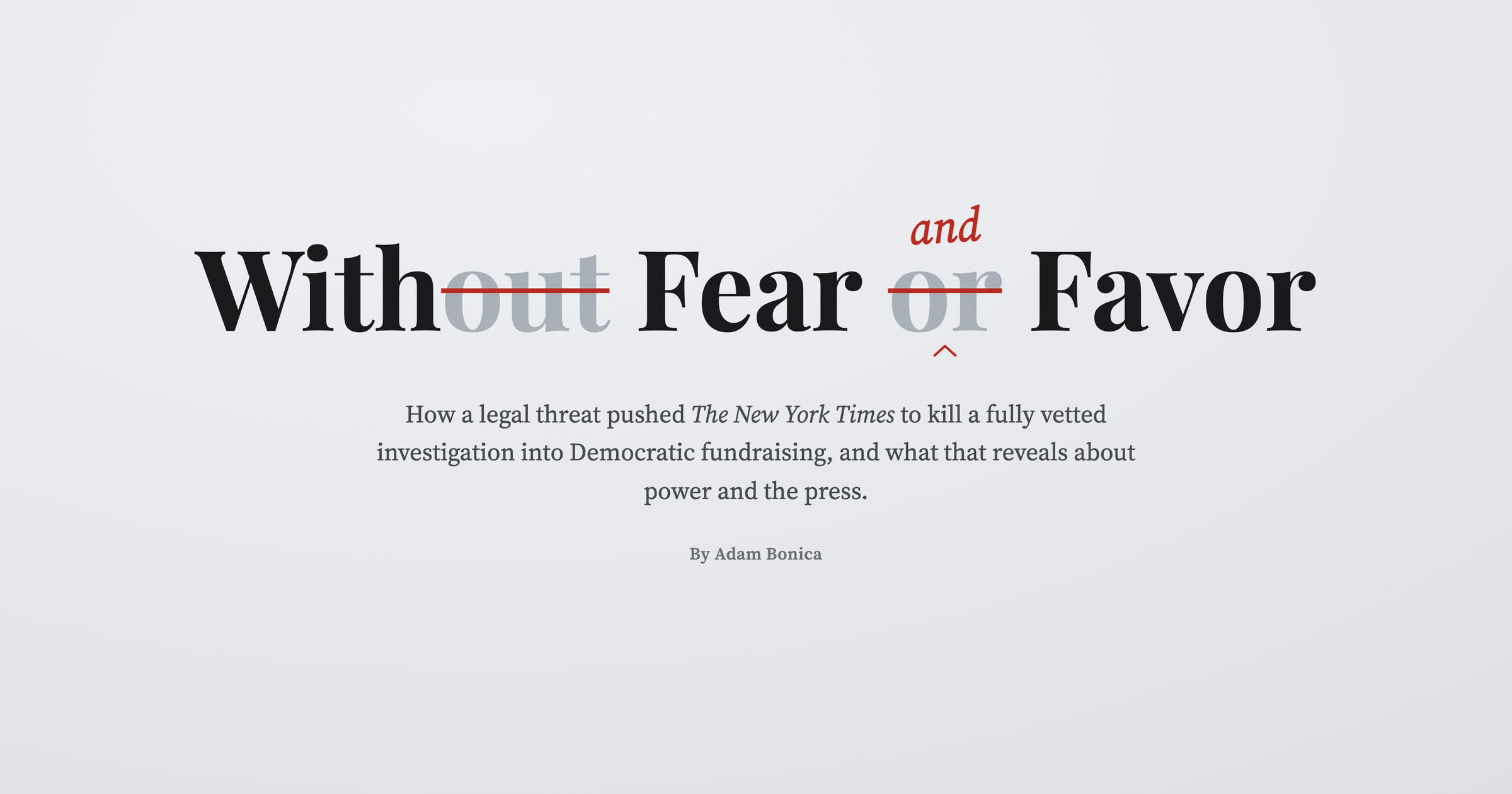
Institutions don’t have courage. They have incentive structures. When incentives line up just right, it is not uncommon for an institution to make a collective decision that almost no one inside it would have made alone. I’ve spent my career studying that machinery in politics. This past year, I watched it operate on The New York Times, which invited me to write an investigation of the Democratic Party’s fundraising practices, vetted it thoroughly, and scheduled a run date.
Shortly after the events I’m about to describe, A.G. Sulzberger, the publisher of The New York Times, stood before a gathering of First Amendment scholars to defend the free press at a moment he called its most serious test in generations. He emphasized that the danger wasn’t only governments banning stories or jailing reporters; it was also threats of civil litigation being weaponized to muzzle reporting. Even an unsuccessful suit imposes real costs, he warned, enough to make a news organization think twice about reporting a story at all.
I had just spent eight months learning how right he was.
What Happened
Following an investigation I published last August, the Times invited me to contribute to its Opinion section. An editorial team was assigned, and we spent months together developing a data-driven investigation into Democratic fundraising, documenting how a network of consultants, vendors, and party committees extracts money from elderly donors through manipulative digital fundraising.
After extensive editing, fact-checking, and graphics work, it was ready. My editor confirmed a publication date of February 17. Requests for comment went out to the subjects of the investigation, a final step signaling that publication is imminent. Everything was on track until the DCCC and DSCC responded with a cease-and-desist letter from the Elias Law Group demanding that the Times not publish. The letter called claims the essay did not make false and defamatory. It did not contest a single claim the essay did make.
The letter, reproduced below, stated that “the Committees do not ‘target’ their email and texting solicitations to the elderly. In fact, neither Committee has the technology or data to do so.” The essay made no such claim. The finding concerns who responds, not who receives the solicitation.
At several points the letter objected to my standing as an outsider:
“Beyond the defamatory nature of these claims, it is difficult to understand how this ‘opinion’ piece furthers the Times’ mission to ‘seek the truth and help people understand the world.’ Mr. Bonica has no knowledge of the Committees’ internal practices and policies and his claims as described by your fact checker are not only misleading, but entirely false — which is ironic given that it appears that his entire thesis is that the Committees are misleading their supporters.”
The findings are built on the committees’ own FEC filings — records the law requires them to make public precisely so outsiders can examine them — and on analysis of fundraising solicitations sent to me and millions of others.

Whether or not the letter had merit, the threat alone was enough to halt publication. The run date was pushed back for legal review. I was assured the Times would proceed unless genuine errors or legal problems emerged. I believed this. The letter’s arguments were frivolous, and the Times prides itself on resisting legal threats. Why would a paper that had invested months developing and vetting an investigation back down over a letter this weak?
No errors or legal problems emerged. What emerged instead were demands on my time. Over the following weeks I answered a continuous stream of requests: a methodology guide, a complete replication archive on GitHub, full datasets for independent verification. As an academic, I’m accustomed to the tedious work of addressing every possible reviewer concern. It rewards patience and humility. I was patient and humble.
What kept me going was what’s inside the data: thousands of people, most of them old, alone with a phone that won’t stop buzzing. The messages are built to frighten and shame — invented deadlines, manufactured crises, the insistence that they alone stand between the country and collapse. Some donate dozens of times a day until a loved one intervenes or the money is gone. After my first investigation, I heard from families who discovered only after a parent’s death how much had been donated. Try to put yourself in the mind of someone who took these messages seriously, who believed what they said. Nancy Pelosi has written to you, personally, and you have let her down. Barack Obama expected more of you. Didn’t you see their desperate pleas? You’re about to lose your Social Security. Everyone in your zip code has donated except you. This is the hellscape of an inbox these vulnerable seniors are trapped inside, where everything is on fire and everyone is screaming for help.
In March, Katie Kingsbury, the head of Opinion, emailed to thank me for my patience “as we finalize your essay for publication” and said her team was taking extra care “to ensure it has the maximum possible impact upon release.” She added: “My colleagues have told me how helpful you’ve been, and we all appreciate it. I’m looking forward to seeing the final version go live soon.”
Progress came in April. The legal department cleared the piece. Fact-checking signed off. A second round of requests for comment went out. The essay was escalated to a masthead editor, who reviewed it favorably and suggested minor edits. A commissioned header graphic was finalized. In total, the piece was subjected to four rounds of fact-checking, and a Times data journalist independently replicated my analysis. Every internal gate had cleared. Still no date.
Then, weeks after its own legal and fact-checking teams had signed off, leadership at the Times killed it. The reasons given: the essay was “too investigative” and read as “too authoritative” for Opinion, and there were concerns about whether fact-checking had the skills to assess the data analysis. The most candid explanation I received was that fallout from a recent Nicholas Kristof column on IDF prisoner abuse had left the paper with no appetite for another “predictable headache.”
This was also the most revealing. The worry wasn’t upsetting readers. Fundraising spam may be the most universally despised artifact in American politics. The only objections came, and could only ever have come, from the consultants and party leaders the essay held accountable. The capitulation was not to controversy but to power.
Why It Happened
The Times had a legally cleared, fact-checked, independently replicated investigation and concluded that publishing it wasn’t worth the trouble. One could call this cowardice, or a betrayal of values. But those are human traits, and this decision wasn’t made by a human. It was made by an institution weighing costs against benefits. The institution decided the costs were higher.
The cease-and-desist letter is better understood as a tool to raise those costs than as a serious legal argument. Lawyers, editors, and a data journalist spent weeks re-clearing an essay that had already been cleared. A legal threat costs its sender far less than it costs its target. As Sulzberger himself warned, even a losing suit is costly to defend against.
Then there is access. Contrary to popular belief, campaign contributions from corporations and special interests are not intended to buy votes in Congress. What they buy is access, for their calls to be returned and the chance to make their case when it matters. Access also yields information that only insiders can provide. News outlets are similar in this respect. The party committees and leaders hold the same currency with newsrooms that they sell to donors. They supply quotes, background, leads to track down, and the occasional leaked document. So when the committees object to a piece, the objection arrives with a standing relationship behind it and an implicit price attached.
None of this excuses the outcome. But one should expect an institution facing legal threats from powerful subjects upon whom it relies to tend toward caution.
Nearly everyone I worked with at the Times was excellent. My editor showed real courage championing the piece through months of internal resistance. The fact-checkers were rigorous. The graphics were strong. Institutions are in some ways more than the sum of their parts, and in other ways less.
Why It Matters
I wrote this investigation to help my party, not to hurt it. Confronted with evidence that a parasitic fundraising ecosystem — the consultants and vendors who profit from it, the committees that have grown dependent on it — is draining the party’s donor base and collapsing its fundraising efficiency, the DCCC and DSCC had every option available to a serious institution. They could have investigated or asked questions. Instead, they hired a law firm to make the evidence disappear.
There’s an unwritten norm that contributors don’t discuss the internal editorial process at the outlets they work with. I was asked not to mention the Times at all. I’m choosing not to honor that norm, because silence about how accountability journalism gets suppressed is itself a form of suppression.
Most journalists who encounter this kind of pressure can’t push back. Most contributors can’t afford to lose a relationship with the Times. The cease-and-desist letter worked on the institution precisely because the institution is vulnerable in ways I am not. I enjoy strong employment protections as an academic and incentives well-aligned with following the evidence and speaking up without fear of losing my job, which is why I can say this when the journalists who face similar pressure often cannot. That’s the chilling effect in practice, a quiet calculation that the cost of publishing exceeds the cost of silence and career repercussions for journalists who challenge powerful media institutions.
Sulzberger’s warning was prophetic. When The Bulwark prepared to publish the investigation, it received legal letters of its own, from Progressive Turnout Project and Mothership Strategies. Capitulation had worked once, so it was tried again. Both letters demanded the piece not run. Both invoked the Times’ decision not to publish. One put it plainly: “Your publication should do the same.” It worked again. What happened next — indefinite delays and a last-minute editorial intervention that removed key empirical findings without explanation and presented the subjects’ legal defenses as my own conclusions — deserves its own accounting, and will get one. The investigation you just read is the one I ultimately had to publish myself.
The Times’ decision to kill the investigation had itself become part of the story, so as The Bulwark prepared to publish, its editors asked me to request comment from the paper. A spokesperson denied that the essay had “secured a confirmed publication date with us or that a Times Opinion fact-checking process was completed.” I found this puzzling, since I have written confirmation of both. After months of watching the subjects of the investigation levy bad-faith denials over findings for which I had the receipts, the Times decided to join in. When shown screenshots confirming a publication date and sign-off by fact-checking, the spokesperson responded: “We stand by the statement provided.”
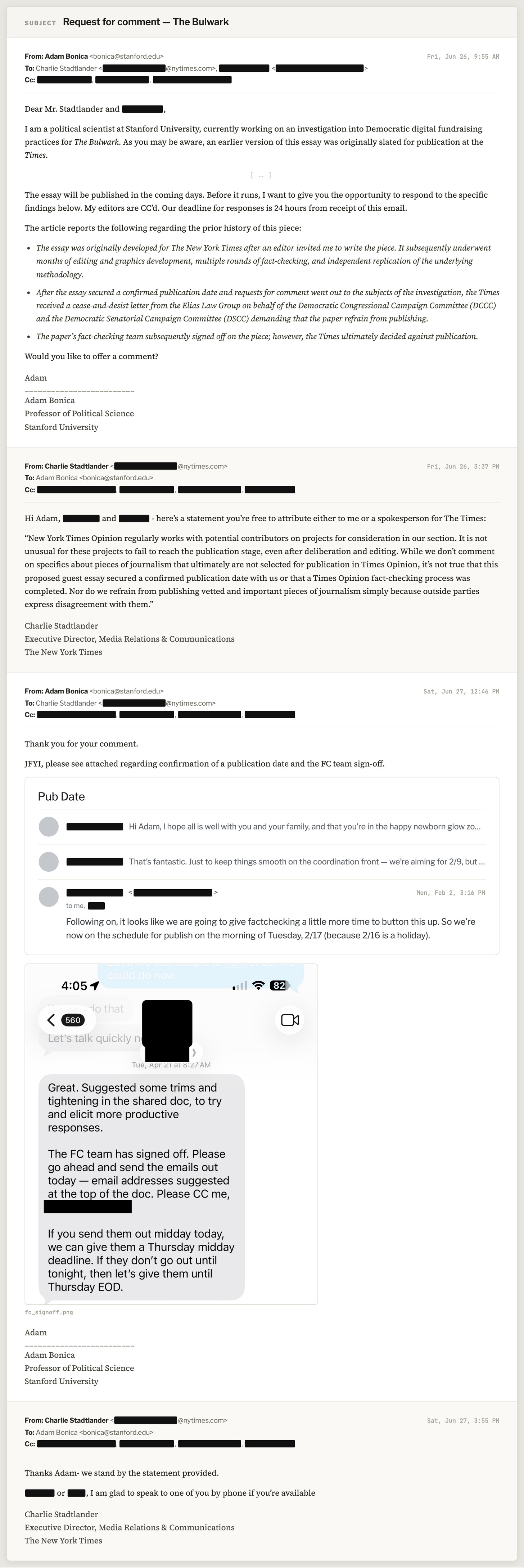
There’s a part of Sulzberger’s speech I saved until now. He gave it the day after my essay was killed, under the banner “We Will Not Compromise on Independent Reporting.” He was withering about media leaders who settle winnable cases and appease the powerful: “Such capitulation, even seemingly small instances of it, serves only to embolden…” He was describing, almost to the word, what had happened inside his own paper the day before. The paper whose promise is to report the news “without fear or favor” — the very phrase Sulzberger reached for in his speech — managed, on this occasion, to do both at once.
Institutions unwilling to hold themselves accountable will fail to hold other powerful actors accountable. The incentives run the same way in newsrooms and in political parties.
The most potent weapon any opposition has against an authoritarian regime is the charge of corruption, and that charge rings hollow when every desperate plea sent under the party’s name validates the cynical belief that both parties are corrupt. If our democracy survives this moment, it will be because the opposition was credible enough and trustworthy enough to sustain a durable majority. That credibility cannot coexist with a fundraising model that exploits the party’s most vulnerable supporters, repels everyone else, and enriches consultants whether the party wins or loses.
The story Democratic leaders suppressed is the one they most need to read.
Wow. This story is amazing. Thank you for your hard work on the original story AND for your commitment to talk about what happened. I hope this gets a lot of attention and ultimately produces change in fundraising strategies.
If I know the New York Times, they are going to publish a shameless rewrite of this story in about three weeks under their own names without any credit to you...